
Choosing the right 90° Peel Strength Tester requires more than comparing prices and display features. In 2026, manufacturers need reliable measurements for labels, tapes, films, laminates, medical packaging, and flexible materials. A suitable tester should apply a controlled 90-degree peeling angle while recording force consistently. Small differences in speed, fixture design, or sample preparation can change the result. That matters in quality control.
This buying guide examines the practical details behind dependable testing. It considers load-cell accuracy, peel speed control, data collection, calibration support, safety features, and software usability. Experienced technicians also check whether the instrument fits their existing standards and laboratory workflow. A bright touchscreen is useful, but it cannot correct poor alignment. Not every advertised specification deserves equal trust. Some instruments perform well in demonstrations but become inconvenient during repeated daily tests. Real samples can curl, stretch, tear, or leave adhesive residue on the fixture.
Look closely.
Reliable purchasing also involves service access, training, replacement parts, and verification records. These factors affect long-term measurement confidence. We will compare common configurations and explain which features support repeatable results. The discussion will also identify limitations that buyers may overlook, including narrow testing ranges and unsuitable grips. No tester is perfect. Even a technically advanced machine depends on careful operators and consistent specimens. Use this guide to question specifications, match the instrument to your application, and select equipment that produces useful evidence rather than attractive numbers.
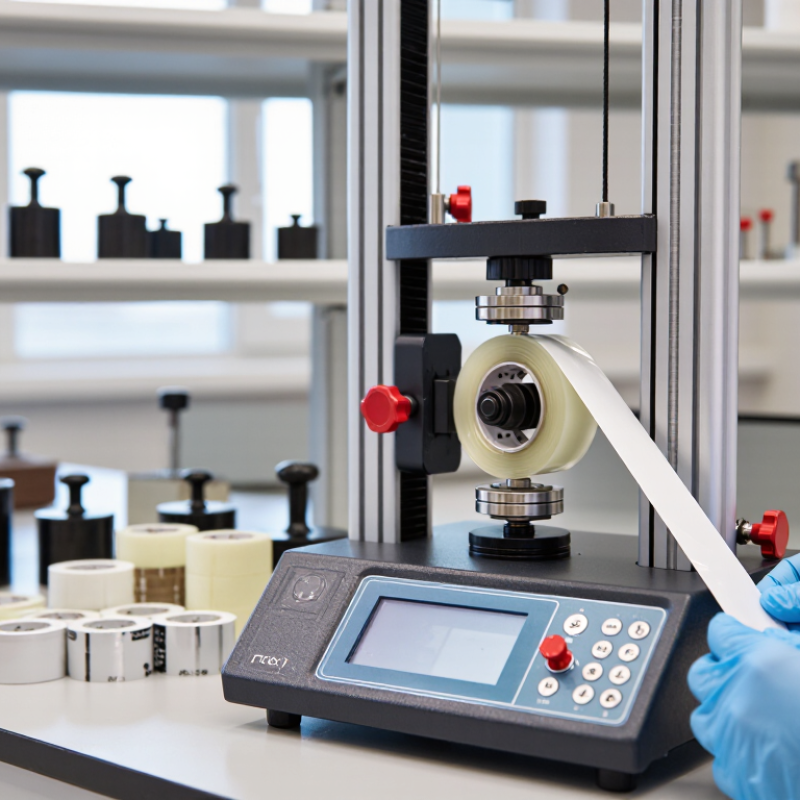
A 90° peel strength tester measures the force needed to separate flexible material from a rigid surface. It reports results as force per unit width, commonly N/25 mm. The test reflects adhesive performance in labels, protective films, medical tapes, and packaging seals. During testing, a prepared strip is bonded, then pulled backward at a controlled 90° angle. The load cell records resistance while the peel arm maintains consistent geometry.
The specimen matters greatly. Surface cleaning, dwell time, backing thickness, and test speed can change the result. Small errors matter. ISO 8510-1 describes a 90° peel method for flexible-to-rigid bonded assemblies. A suitable tester should support precise speed control, stable clamping, calibrated force measurement, and clear data export. Grand View Research estimated the pressure-sensitive adhesives market at about USD 13.2 billion in 2023, with continued growth through 2030. That expansion increases the need for repeatable verification, not just attractive numbers.
When comparing a 2026 tester, inspect its angle fixture and calibration records before its touchscreen. Look for simple alignment checks. A practical bench test should show smooth peeling, without sudden frame vibration or specimen slipping. I would also request repeatability data across operators and temperatures. One clean result proves little. Humidity can quietly distort it. Some laboratories still treat peel strength as a single material property, which is an oversimplification. The interface, preparation method, and operator all influence the final curve.
2026 Best 90° Peel Strength Tester Buying Guide
A reliable 90° peel strength tester should match the exact test method, material, and failure mode. ASTM D6862 and ISO 8510-1 are useful references for many adhesive peel evaluations. However, their specimen designs and reporting requirements differ. Check the latest standard before purchasing. A 180° peel procedure cannot replace a 90° method.
Angle matters. The fixture should maintain a stable 90° direction throughout the test. Even slight alignment errors can change the measured force. Look for a rigid frame, adjustable clamps, and a low-friction peeling mechanism. The load cell should suit your expected force range, not merely provide the highest capacity. Excessive capacity may reduce measurement sensitivity. A practical system should offer calibrated accuracy, clear force resolution, and a controlled test speed. Data sampling must capture sharp peaks without creating artificial noise.
In production testing, I also examine specimen width, grip compatibility, and environmental control. Temperature and humidity can soften adhesives or make flexible films brittle. Confirm whether the tester supports conditioning requirements from your selected standard. Software should record average peel force, peak force, distance, and failure observations. Exportable raw data improves traceability. Small details matter. I once underestimated clamp alignment, and repeatability suffered. No tester is perfect. Operators still need training, regular calibration, and honest review of unusual results.
2026 Best 90° Peel Strength Tester Buying Guide
Choosing a 90° peel strength tester starts with the material, not the instrument. Flexible films, labels, tapes, laminates, and coated papers can produce very different peel curves. ASTM D6862 and ISO 8510-1 provide recognized 90-degree testing methods, but their specimen preparation and reporting details differ. Check the required standard before comparing machines.
A suitable tester should maintain a true 90° peeling angle, stable speed, and consistent clamping. Select a load cell that places normal results near its working range, rather than near zero. A narrow film may need a lower-capacity cell than a thick laminate. Look for calibrated force measurement, clear data recording, and fixtures that prevent sample slipping. Environmental control also matters. Temperature and humidity can change adhesive behavior within minutes.
The market context is significant. Smithers’ industry report, The Future of Global Packaging to 2028, forecasts the global packaging market will exceed US$1.2 trillion by 2028. More packaging variations mean more testing conditions. Do not judge a tester by peak force alone. Average peel force, failure mode, noise, and curve shape can reveal weak bonding or uneven coating. A clean graph may still hide poor sample preparation. In practice, I would compare repeatability across several specimens and record conditioning time carefully. That step is often overlooked.
The chart shows representative 90° peel-force ranges for common material constructions, expressed in N/25 mm. These ranges are intended for preliminary tester selection only; actual results depend on adhesive chemistry, substrate, dwell time, temperature, test speed, and specimen preparation. For routine testing, choose a tester whose capacity comfortably exceeds the highest expected force and verify the method against the applicable standard, such as ASTM D3330 Method F or ISO 8510-1.
Typical reference conditions: 90° peel angle, 25 mm specimen width, and a controlled crosshead speed commonly set at 300 mm/min for pressure-sensitive adhesive testing.
A reliable 90° peel strength tester must control angle, speed, and load consistently. ASTM D6862 specifies a 90° peel method for measuring flexible packaging seal strength. Choose a rigid fixture that keeps the specimen aligned without twisting. A high-resolution load cell helps capture small force changes, while automatic zeroing reduces operator error. According to NIST Technical Note 1297, measurement results should include uncertainty, not only a single force value. That detail is easy to overlook.
Safety supports accuracy, too. Look for a transparent guard, emergency stop, overload protection, and stable sample clamps. During routine testing, loose film can snap back sharply. A guarded chamber keeps hands away from moving parts. The tester should also record peel force, displacement, speed, and test ID automatically. ASTM E4 emphasizes proper verification of force-measuring systems, so scheduled calibration with traceable reference loads is essential. Do not trust factory settings forever.
Efficiency depends on practical workflow. Select programmable speeds, quick-release grips, and exportable data formats. These features reduce repeated setup and transcription mistakes. The Flexible Packaging Association’s 2024 industry report shows the scale and complexity of flexible packaging production in the United States, making repeatable testing increasingly valuable. Still, faster testing is not always better. Excessive speed may hide material behavior or create heat-related variation. I would compare at least five specimens per condition and review abnormal curves manually. Machines help, but judgment remains imperfect.
When buying a 90° peel strength tester, supplier capability matters more than a polished brochure.
ASTM D3330 and ISO 8510-1 define common peel methods, but they do not guarantee identical equipment performance. Ask for speed accuracy, load-cell resolution, travel length, and raw-data export. A 5% discount means little if replacement sensors take eight weeks.
Pricing should include installation, software updates, training, and calibration. Compare the total cost over three years, not only the purchase price. Require a calibration certificate linked to national measurement standards, preferably from an ISO/IEC 17025-accredited laboratory.
The NIST Technical Note 1297 explains why measurement uncertainty must accompany test results. This detail is often ignored. It should not be.
Tips: Request a sample test before ordering. Use your actual adhesive, liner, and peel speed. Check whether the supplier can provide traceable calibration, spare parts, and response-time targets. Industry testing guidance commonly recommends documenting specimen width, conditioning, angle, and speed. Small omissions can change the result. After-sales support is practical evidence of supplier reliability. Ask for service records, remote troubleshooting options, and a written repair process. A cheaper instrument may still be the wrong investment. I would also question vague claims such as “high precision” without repeatability data, because marketing language is not a calibration result.


