
A Heat Transfer Tank may look like a steel vessel, but its job is active: it stores or circulates a working fluid and moves heat where a process needs it. Picture hot water or thermal oil flowing through a coil while a separate product warms inside the tank. The fluids exchange energy without necessarily mixing. Insulation slows heat loss; sensors and controls help keep temperatures steady. The details matter. Poor circulation can leave cold zones, while unsuitable materials or operating conditions can shorten equipment life.
The International Energy Agency’s industry analysis reports that industry accounts for about 37% of global final energy use. That figure puts process heating in a larger context: efficient heat management can influence operating costs and energy demand. A tank alone does not guarantee savings. Design, maintenance, fluid choice, and control settings all affect performance. Heat-transfer specialist Yunus A. Çengel’s work explains the underlying principle: thermal energy moves from warmer regions to cooler ones. This is a paraphrase of the principle, not a direct quotation. In practice, that simple rule becomes a system of pumps, heat exchangers, insulation, and temperature controls. A clear understanding of how a Heat Transfer Tank works helps engineers and operators assess its role before selecting or troubleshooting one. Even a small temperature difference can matter. Reliable performance starts with measured conditions, not guesswork.
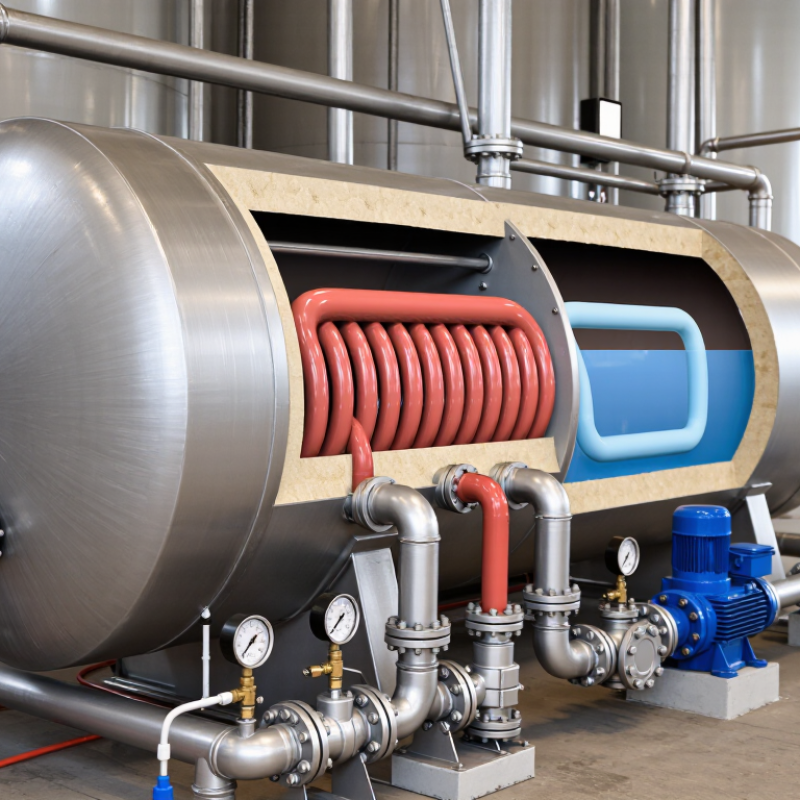
A heat transfer tank is a vessel designed to move heat into or out of a liquid used by a heating or process system. Depending on its design, it may hold the process liquid directly or contain a separate heating fluid. A coil, jacket, or internal heat exchanger carries heat between the fluids without necessarily mixing them. The name can be confusing, because tank layouts and functions vary.
Its purpose is to provide a controlled place for heat exchange and, in some systems, temporary heat storage. For example, warm water may flow through a coil while cooler water in the tank absorbs heat. The tank’s volume can help steady temperatures when demand changes. That matters. It may also reduce rapid cycling of a heat source, though the result depends on correct sizing and system controls.
In practice, operators monitor inlet and outlet temperatures, flow, and signs of scaling or corrosion. A tank that is too small may struggle to meet demand; an oversized one can take longer to warm. Not every setup needs stored heat, and a tank alone cannot correct poor circulation or control settings. The details deserve a closer look before choosing a design.
A heat transfer tank holds a liquid that gains or releases heat through a separate heating or cooling circuit. The tank shell contains the process liquid. Inside it, a coil or surrounding jacket carries the heat-transfer fluid, keeping the two liquids apart. Heat passes through the metal surface. No direct mixing. The coil’s area and flow rate affect how quickly the tank changes temperature, so a small coil may struggle when demand rises suddenly.
Insulation around the shell slows heat loss and helps maintain a steady temperature. Inlet and outlet ports guide both liquid circuits, while drains make cleaning and maintenance easier. Temperature sensors measure conditions at selected points; one sensor near the outlet may not show uneven temperatures inside a large tank. A circulation pump moves the heat-transfer fluid through the coil, and control valves adjust its flow. Pressure-relief devices protect the system if pressure climbs beyond its safe operating range. Small details matter. Tank sizing can be less obvious than it looks: product viscosity, batch volume, and target heating time all affect performance.
Heat moves through a heat transfer tank by conduction, convection, and sometimes fluid flow through a coil. A heated coil conducts energy through its metal wall into the surrounding water or other storage fluid. The warmer fluid becomes less dense and rises, while cooler fluid sinks. This circulation spreads heat, though pumps may be used when natural movement is too slow.
ASHRAE’s Handbook—Fundamentals lists water’s specific heat near room temperature at about 4.18 kJ/kg·K. In practical terms, each kilogram of water needs roughly 4.18 kilojoules to warm by one degree Celsius.
Tank shape and flow can change how evenly that energy spreads. Real tanks are less tidy: inlet jets can disturb temperature layers, and sensors may not capture every hot or cool pocket.
The U.S. Department of Energy reports that insulating a water-heater tank can reduce standby heat losses by 25%–45%; insulation quality therefore affects how much stored heat escapes.
Tips: Check the inlet and outlet positions, insulation condition, and temperature readings at different heights. A quick surface check alone can mislead. Keep records over several operating cycles.
A heat transfer tank stores a heated fluid and moves its energy to a process, often through a coil or jacket. In a typical cycle, a burner, electric element, or external heater warms the fluid. A pump then sends it through the heat-transfer circuit, where the tank wall or internal coil passes heat to the product. The fluid returns cooler and is reheated. Simple in principle.
A temperature sensor signals when the set point is reached, allowing the heater to modulate or pause. Flow and temperature controls help prevent uneven heating; insulation slows heat loss while the system waits. The cycle changes with the fluid, load, and equipment design, so operators should follow the vessel’s specifications rather than assume every tank behaves alike. DOE’s 2015 Quadrennial Technology Review reports that process heating represents about 36% of manufacturing energy use. That makes circulation, insulation, and control settings more than small details.
During startup, a cold product can absorb heat quickly, and the return fluid may lag behind the tank reading. Operators should watch both temperatures and check for steady flow.
The U.S. Department of Energy’s 2022 Industrial Decarbonization Roadmap estimates industry produces about 30% of U.S. energy-related carbon emissions. That figure covers industry broadly, not heat-transfer tanks alone. Still, it puts routine operating losses in perspective. Real systems can be less tidy than the diagram; sensor placement and changing batch sizes matter.
What Is a Heat Transfer Tank and How Does It Work?
A heat transfer tank stores liquid while controlling its temperature through indirect heating or cooling. A jacketed tank surrounds the vessel with a heated or chilled fluid. An internal-coil tank uses a submerged coil for closer heat exchange. Shell-and-tube systems suit larger, continuous-duty processes, although they may need more floor space and maintenance.
Common applications include food mixing, pharmaceutical preparation, chemical batching, wastewater treatment, and HVAC thermal storage. In a food plant, hot water flowing through a jacket can warm viscous sauce without direct contact. In a pharmaceutical vessel, precise temperature control protects sensitive ingredients. The International Energy Agency’s Energy Efficiency 2023 report states that industry used about 37% of global final energy in 2022. Better heat transfer design can reduce avoidable losses, but actual savings depend on insulation, circulation, operating temperature, and cleaning schedules. The U.S. Department of Energy’s Industrial Decarbonization Roadmap also identifies process heating as a major improvement opportunity.
Tips: Match the tank material to the fluid, pressure, and cleaning method. Measure heat-up time under real production conditions, not only laboratory conditions. Keep sensors near the working zone. A small placement error can create misleading temperature readings. I have seen designs overemphasize maximum heating power while ignoring mixing quality. That approach looks efficient on paper, but uneven temperatures may extend batch times. Tank sizing also deserves reflection: oversized equipment loses more standby heat, while undersized vessels may disrupt production.
A heat transfer tank stores or circulates a fluid that absorbs heat from a source and transfers it to a process, building, or secondary loop. The chart shows representative operating-temperature ranges for common heat transfer tank systems.
Water systems are widely used for low- to moderate-temperature heating. Glycol systems provide freeze protection, thermal-oil systems support higher-temperature processes without pressurizing water, and molten-salt tanks are used for high-temperature thermal storage. Actual limits depend on fluid formulation, pressure, materials, insulation, and tank design.


